
From Tech Pack to Bulk Production: A Step-by-Step OEM Manufacturing Blueprint
A clear, transparent walkthrough of the 6 core stages of custom sports apparel production for brand founders and supply chain directors.
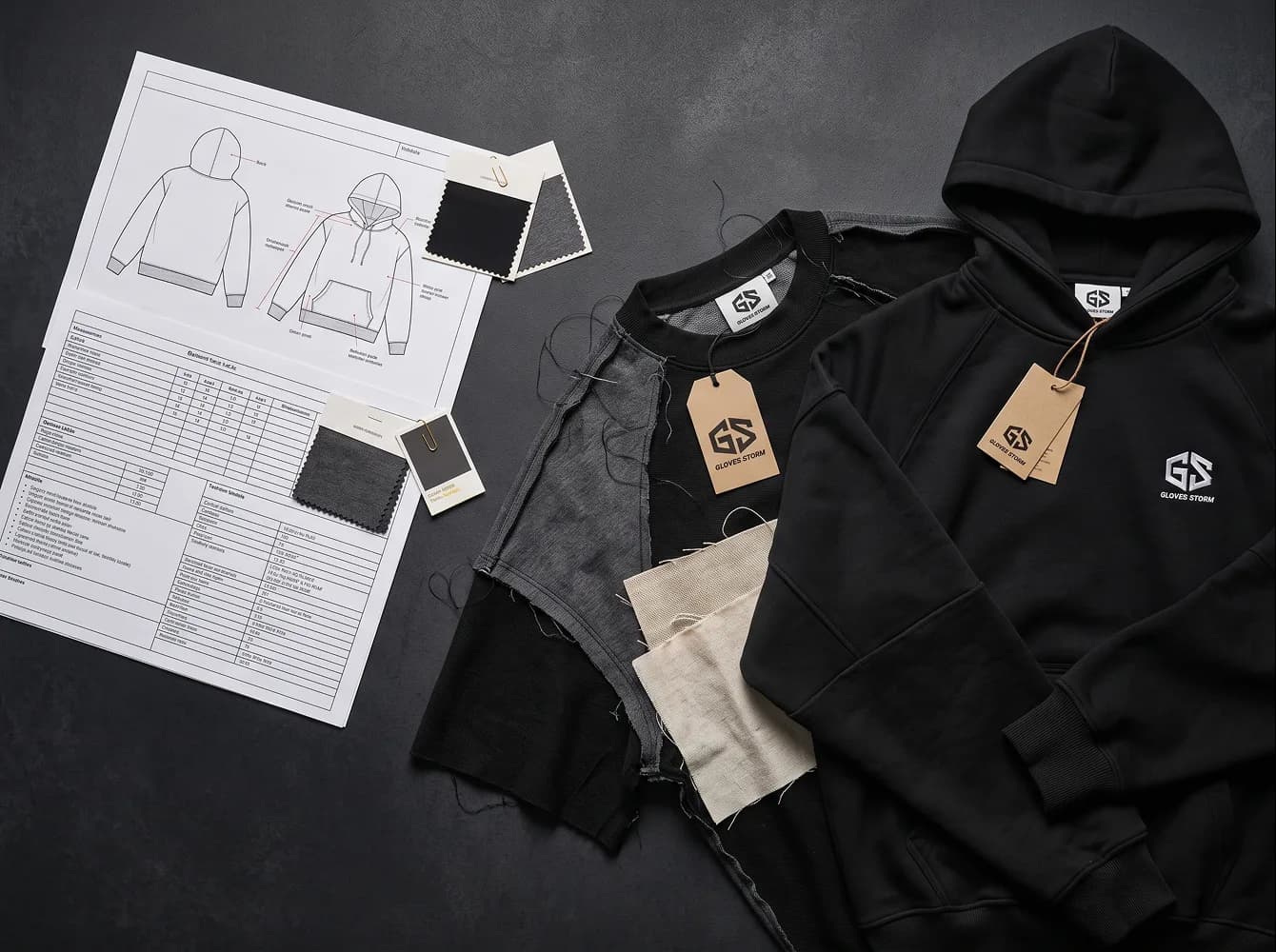
Navigating the OEM Clothing Manufacturing Journey
Transitioning an apparel concept from an Adobe Illustrator mockup into thousands of retail-ready garments packed into export cartons is one of the most critical phases in building a profitable fashion or sportswear brand. For independent founders, the manufacturing process can often feel opaque, intimidating, and fraught with financial risk.
At Gloves Storm, we operate our Sialkot manufacturing facility with complete operational transparency. Below is the exact, step-by-step technical pipeline that transforms your concept into retail-ready bulk stock.
Step 1: Technical Spec Sheet Review & Yarn/Fabric Sourcing
Every successful production run starts with rigorous engineering analysis. When you submit your apparel design or tech pack, our textile engineers analyze:
- Fabric Yarn Specifications: Combed cotton, micro-poly, polyamide elastane blends, yarn counts (e.g., 20s, 30s, 40s), and target weight (GSM).
- Color Matching: We match your digital color codes to physical universal Pantone TCX or TPX color standards, ensuring flawless dye-lot fidelity.
- Stitch Construction: Defining seam architectures—such as 4-needle 6-thread flatlock for athletic garments, dual-needle topstitching for streetwear, or bar-tack reinforcement at high-stress pockets.
Step 2: Digital Grading & 3D Pattern CAD Engineering
Grading is the mathematical process of scaling a base size pattern (typically Size Medium) up to 3XL and down to XS. Inexperienced factories scale sizes uniformly, resulting in disproportionately wide neck openings or overly long sleeves.
Our pattern engineering team utilizes industry-standard Gerber and Optitex CAD software. We apply proven athletic and streetwear grading curves calibrated specifically for North American and European anatomical proportions, ensuring that every size fits naturally and comfortably.
Step 3: Physical Prototyping & Master Sample Sign-Off
Never authorize bulk production without testing a physical prototype in your hands. During this stage:
- We build a complete physical master prototype using your selected fabric, trim accessories, and specified embellishment methods.
- We dispatch the prototype to your design studio via DHL Express (typically 3 to 5 business days transit).
- You perform live fit testing, wash tests, and inspect construction details. Any necessary tweaks—such as lengthening a hem by 1.5 cm or adjusting waistband elasticity—are locked into the master CAD file before fabric rolls are cut.
Step 4: Automated Laser Cutting & Flat-Panel Customization
Once your master sample is approved, bulk fabric rolls are tension-relaxed on spreading tables for 24 hours to prevent post-cut shrinkage. The fabric is then cut with computerized precision cutting machinery to maintain dimensional accuracy within ±1 millimeter.
Crucially, high-definition embellishments—including Italian dye sublimation, automated screen printing, chenille patches, and 3D silicone transfers—are applied to the flat, pre-cut panels before stitching. This ensures pinpoint graphic alignment across seams and eliminates crooked placements.
Step 5: Industrial Assembly & Specialized Seaming Lines
Sewing is performed in specialized, dedicated factory cells:
- Performance Activewear Line: Equipped with automated Yamato and Juki 4-needle flatlock machines that produce flush, chafe-free seams.
- Heavyweight Streetwear Line: Fitted with heavy-duty walking foot machines engineered to pierce 450+ GSM French Terry and heavy rib knit trims without needle deflection.
- Sublimated Sportswear Line: Specialized operators assemble moisture-wicking jerseys and team uniforms with reinforced bar-tacks and dual-stitched hems.
Step 6: AQL 2.5 Quality Inspection & Worldwide DDP Delivery
Before any carton leaves our factory floor, finished garments undergo strict AQL (Acceptable Quality Limit) 2.5 quality audits. Every item is inspected for loose thread trimming, seam pull strength, dimensional tolerances, and barcode tag placement.
Goods are individually packed into branded frosted polybags, placed into heavy 5-ply export master cartons, and shipped via Delivered Duty Paid (DDP) air express or ocean freight. Gloves Storm manages customs clearance, tariff documentation, and final carrier delivery straight to your warehouse door in the USA, UK, Canada, or Europe with zero surprise fees.
GLOVES STORM Editorial
Technical Apparel SpecialistThe technical textile engineering and production team at Gloves Storm, specializing in custom sportswear, performance knit development, pattern grading, and international private label apparel manufacturing based in Sialkot, Pakistan.
Frequently Asked Questions
Essential answers regarding custom manufacturing, minimum order quantities, sampling, and private labeling.
More From The Journal
How Much Does It Cost to Make a Hoodie? Real 2026 Factory Prices
Real 2026 factory prices for custom hoodies: $28–$35 per piece from 30 pcs, add-on costs, sample prices and a full budget example for your first drop.
Product GuidesBJJ Rash Guard Manufacturer Guide: Fabric, Sublimation & Ranked Designs
How custom BJJ rash guards are made: 200 GSM nylon-spandex, flatlock seams, sublimation that won't crack, ranked designs, and low MOQ from 30 pieces.
OEM GuidesPakistan vs China Clothing Manufacturers: Which Should You Choose? (2026)
Pakistan vs China for clothing manufacturing: compare MOQs, fabrics, landed cost, EU and US duties, lead times and quality control before your first order.
Prototype Your Custom Design
Test your branding, select leather or technical fabric densities, and request an instant manufacturing quote directly from our Sialkot factory team.
Have questions about material specifications?
Speak directly with our technical textile team to get sample swatches and pricing.